


Designing an Ecosystem Map for a Refettorio (Community Hub) for People Experiencing Homelessness in Chicago
Duration: 6 months
My Role: Human-centered Design Expert and Lead
CHALLENGE
-
68,440 people were experiencing homelessness in Chicago, Illinois in 2021 and excluded from mainstream community spaces.
-
Our client wanted us to provide a service design for a Refettorio they wanted to be built in Chicago, providing services and physical space to people experiencing homelessness.
-
Our client also wanted the design to be informed by evidence-based solutions as many policies and programs targeting homelessness remain arbitrary without taking into consideration the needs of people and stakeholders influencing them.
SUCCESSES
-
I was able to advocate for and convince our clients and my team about the importance of using HCD in data collection with hard-to-reach populations and involving diverse stakeholders. This was challenging because of using traditional ways of researching and analyzing data, however, both clients and team members were happy to see how design methods helped us connect to the user more and engage diverse stakeholders.
-
My client received funding and appreciation from policymakers based on the ecosystem map and recommendations my team gave to our client.
-
Despite conflicts around methodology and deliverables - which helped us iterate on our final design of the ecosystem map, we met our timelines while maintaining collaborative efforts and feasibility.
FINAL PRODUCT: An actionable Ecosystem Map
Iterate, Iterate, Iterate
Our client expressed concerns about the first design of the ecosystem map. They needed an ecosystem map to show funders, architects, and stakeholders their priorities for building the refettorio. They wanted to depict priority resources and services, however, it was challenging to pinpoint the most essential resources and services, as user research highlighted varying priorities based on individual participants.
I explained to our client that the insights from the user research and ideation sessions expressed priorities around the themes that my team and I had formed and those priorities can not be ignored. However, I also understood our client's concerns and needs and thus led them through a prioritization exercise where I helped them identify top priorities as builders and service providers.
One of the key priorities of our client was to keep food and meal services at the center through which the participant entering the refettorio would interact with the whole space.
After several rounds of feedback and iterations, I created an actionable ecosystem map for our client within the timeline depicting different categories of services, critical elements of physical design and space of the refettorio and also defining values and principles of how the Refettorrio should function. Our client was happy and satisfied with this final iteration.
.png)
Actionable Ecosystem Map
HOW DID I REACH TO THE FINAL PRODUCT?
This was a complex social issue.
As the human-centered design lead, I led my team and clients through a design process to understand the needs of people experiencing homelessness and get insights for ts on the functioning of the Refettorio from stakeholders providing resources and services, funders, and policymakers.

USER RESEARCH
My team and I conducted 3 focus group discussions with 25+ people experiencing homelessness and decided to focus on the following broad questions to meet client needs:
-
A typical day in the life of a person experiencing homelessness.
-
How participants rank resources and services like housing, hygiene products, and food.
-
What an ideal refettorio looks like to participants.
-
The ideal location for a refettorio in Chicago.
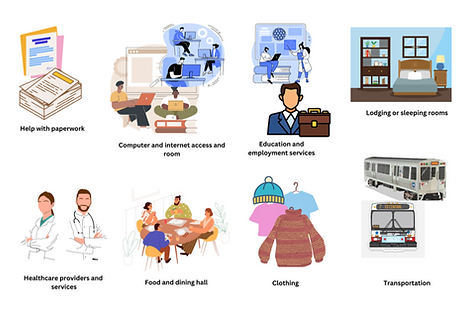
I led the development of interview tools, using methods like card sorting, showing pictures of refettorios, and asking participants to mark ideal locations on a city map. I prioritized using visual tools to account for the literacy levels of the participants
IMAGES USED FOR CARD SORTING EXERCISE
EMPATHY MAPPING
After each user focus group, I led my team in empathy mapping to capture insights, observations, and clues. Recording and transcribing were impractical due to the large groups and limited facilitators. Using techniques like card sorting and picture selection, we needed to document not just choices and rankings but also the reasons behind them and any observed patterns. Empathy mapping allowed us to succinctly and clearly capture this data.

An example of the three empathy maps I led my team to create after every focus group
CLIENT PUSHED FOR PERSONAS
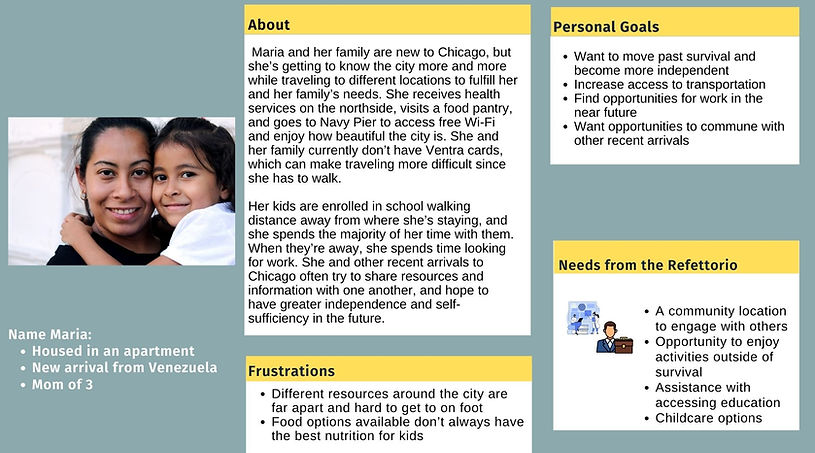
Our clients wanted a more condensed visual to understand user needs and pinpoint challenges. In response, I guided my team to transform the empathy maps into three user personas representing the different focus groups. This adjustment met the client's needs and ensured we stayed on track to move to our next step of ideation sessions. Each persona described who our user is, their goals, frustrations, and what they need from the refettorio.
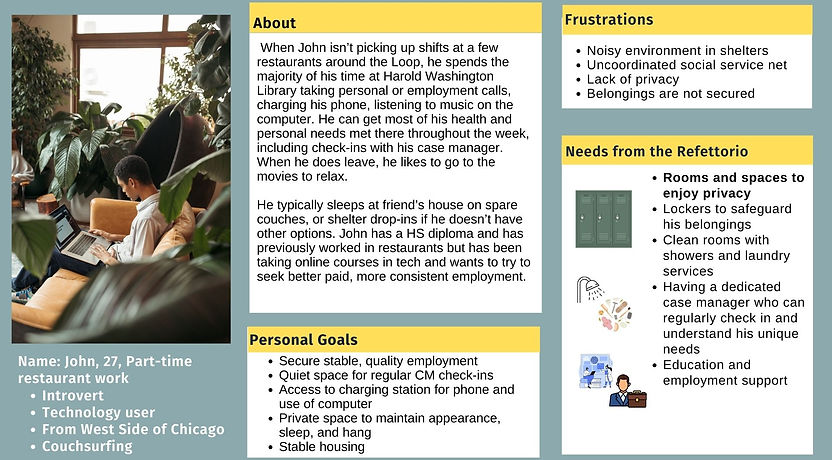
Persona 1 portrays John, an introverted individual focused on career goals. He seeks privacy, security, and support to advance his employment opportunities at the refettorio.
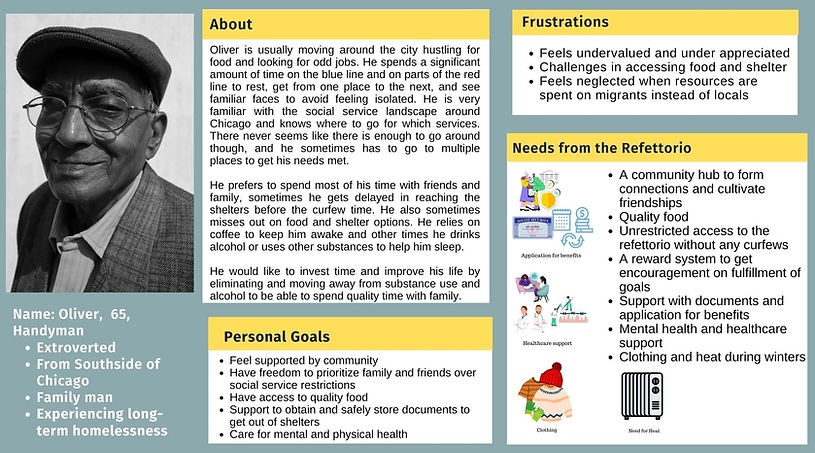
Persona 2 describes Oliver, an extrovert who hustles for work in the city and seeks to build community relationships and have unrestricted access to the refettorio.
-
Persona 3 depicts an immigrant mother new to Chicago. She desires nutritious food at the refettorio and envisions it as a space for opportunities beyond survival and also seeks childcare support.
The client was satisfied with the personas and found them important deliverables that could be used for our ideation sessions where all stakeholders would come together to ideate on the design of the ecosystem map of the Refettorio.
People with lived experience
Case Manager
Program Manager
Funder
Policymakers
Stakeholders involved in Ideation Sessions
IDEATION SESSIONS
My team and I translated our gathered data into user personas to grasp the unique challenges, needs, and goals of participants. With these insights, we convened a diverse group of stakeholders—individuals with lived experiences, case managers, program managers from homeless shelters, funders, and policymakers. Together, we ideated on four broad categories essential for designing the ecosystem map of the refettorio:
-
Occupants of the Refettorio: Who else, besides participants, should occupy the space?
-
Physical Space Design: What should the physical space of the refettorio look like?
-
Services and Resources: What services and resources should be provided, and which should be prioritized for direct provision versus referrals?
-
Policies: What policies should the refettorio have in place?
To facilitate this ideation, we organized stakeholders into four teams, each discussing one of the categories, with a dedicated facilitator guiding each group. After an initial round of discussions, stakeholders rotated to different groups to contribute their insights across all categories. To prioritize ideas, stakeholders rated their top and favorite suggestions using stars. This collaborative and iterative process ensured a comprehensive and inclusive approach to ideating the design of the refettorio's ecosystem map.
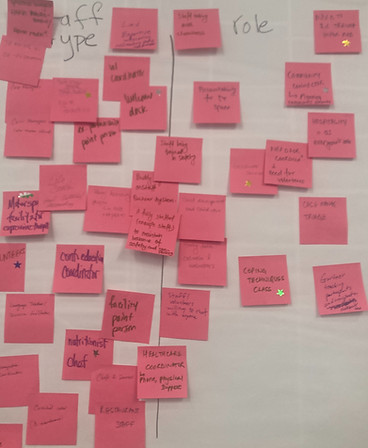
WHO SHOULD OCCUPY THE SPACE?
Stakeholders brainstormed on post-it notes about who should occupy the refettorio, besides participants, and their roles. They emphasized creating a chef community and engaging various community volunteers to support the refettorio's functioning. As stakeholders moved around the group, they voted on top ideas using stars.
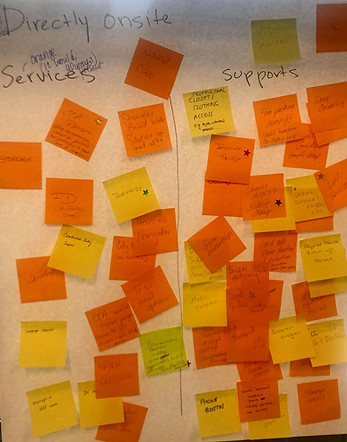
WHAT SERVICES SHOULD BE PROVIDED?
Stakeholders also brainstormed ideas on what services should be provided at the refettorio. Notable suggestions included offering immediate triage, providing services that go beyond meeting basic survival needs, and offering healthcare services onsite.
INSIGHTS FROM IDEATION SESSIONS
Staff, services, and resources provided at the refettorio should be trauma-informed
There should be few barriers to entry and low eligibility criteria to enter the refettorio
Refettorio should provide safety and security to participants but should not be policed
THE ECOSYSTEM MAP
Based on the insights and ideas gathered from the ideation sessions, I led my team through a theming process where we grouped similar ideas and identified recurrent insights. We developed four themes:
-
Essential and Basic Needs Support
-
Trauma-Informed Support and Healthcare Services
-
Life-Enhancing and Advancing Supports
-
Providing Safety and Security
I created an ecosystem map that highlighted these themes across different tiers: staff, physical space, and internal and external services and resources.
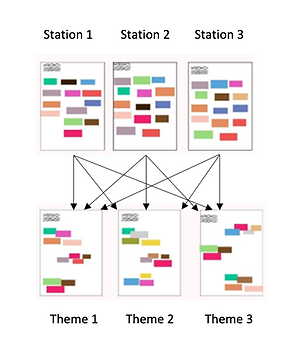
THE THEMING PROCESS
We discussed how to group different ideas from 'stations/groups' of stakeholders and categorized similar ideas and insights together to form themes.
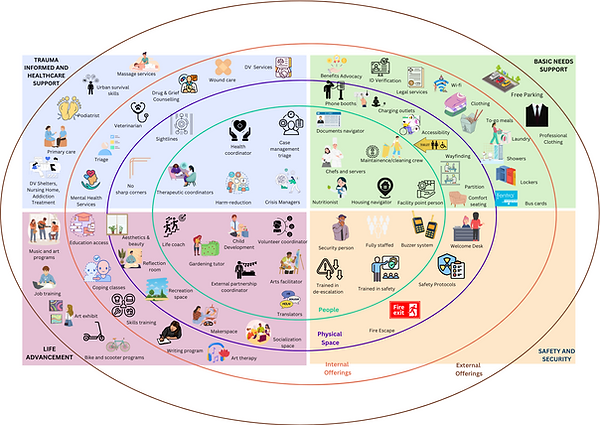
ECOSYSTEM MAP
Based on the theming of ideas, I designed an ecosystem map to describe the functioning of the refettorio. The first tier outlined the staff and other occupants of the refettorio. The second tier detailed the physical space, including design and architectural elements. The third and fourth tiers described the internal and external resources and services to be provided. I chose an ecosystem map to give our client a comprehensive picture of how users would interact with the space, people, and resources. This map illustrates how different components of the refettorio work together to meet users' needs and goals.